
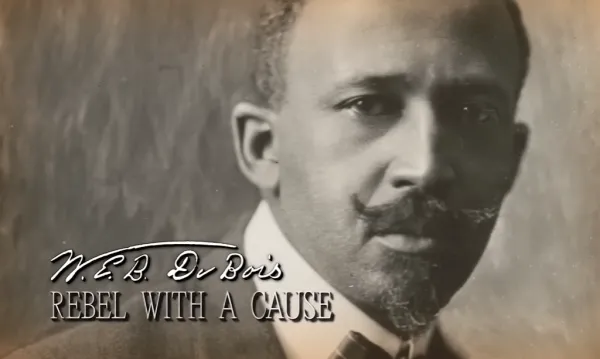
Appropriated from the 1955 cult classic titled Rebel Without a Cause starring bad boy James Dean and Natalie Wood, Rita Coburn’s 2026 documentary of W.E.B. DuBois: Rebel with a Cause is a well-done biopic of one of the 20th century’s foremost intellectuals but despite some of the reviews it is not particularly groundbreaking, especially for those who are familiar with Louis Massiah’s late 1990’s W.E.B. DuBois: A Biography in Four Voices. That work is sectioned into four eras, with each period written and narrated by a well-known African American intellectual/writer. A People magazine reviewer wrote that in Coburn’s documentary DuBois “gets a long-overdue close-up.” Nothing could be further from the truth unless the writer is referring to the very personal aspects of DuBois’s life that were included in the film but adds little to one’s understanding of the things for which DuBois stood and was best known. In this writer’s opinion some things are not for public consumption and should be left private. I need not know every sordid detail or every reportedly traumatic event of a person’s life (in the case DuBois) to appreciate that individual’s contribution to the humanities, arts, social sciences and world civilization.
Undoubtedly influenced by Massiah’s work, Coburn’s documentary also features several prominent African American figures as narrators including rapper/actor, Common. For those who are students of 20th century Black Political Thought few will find very little in Coburn’s documentary of intellectual import with which they are unfamiliar.
For nearly two hours the film attempts to cover the arc of DuBois’s life. Of course, some aspects are covered more thoroughly than others. Attempting to cover in two hours the entirety of one’s life, especially someone like DuBois who lived to be the ripe old age of 95 and whose work in the struggle for freedom, justice and equality spanned several decades is a near impossible task. For example, DuBois was a prolific writer, yet the Souls of Black Folk and The Philadelphia Negro are the works with which the documentary seems most enamored. Neither book is the subject of a deep dive by the narrators, but novices will find their curiosity sufficiently piqued that they will want to learn more. One claim that discerning listeners might have found somewhat hard to believe is that during the less than a year and a half DuBois lived in the city of Brotherly Love, he interviewed 5000 people for his 1899 book The Philadelphia Negro. Whatever the actual number, The Philadelphia Negro is a classic work that has stood the test of time, but of course that could be said for any number of his texts including Black Reconstruction in America.
DuBois was one of the world’s foremost intellectuals of any era, yet the documentary doesn’t fully capture his impact in that regard. Sure, he made a lasting impression on the disciplines of history and sociology, and he his presence in the arts was evident by his poetry and fiction writing, but one could easily argue that his influence on political science and criminology was just as profound. W.E.B. DuBois: Rebel with a Cause is a worthwhile watch and a terrific primer for those who endeavor to learn more about this giant of a man.
W.E.B. DuBois: Rebel with a Cause is 1h 52m. Director and writer, Rita Coburn. Episode aired May 19, 2026
Judson L. Jeffries, PhD, MPH, is Professor of African American and African Studies at The Ohio State University.